
Pocahontas County Arrest Warrants Explained
Iowa Code section 804.1 sets the central rule for how an arrest warrant gets issued here. A complaint goes to a magistrate. When the complaint and its supporting affidavits show probable cause that an offense happened and that the named person committed it, the magistrate signs the warrant unless the law allows a citation instead. The judicial officer alone makes that call. In Pocahontas County, the County Attorney prosecutes adult indictable offenses in District Court and simple misdemeanors in magistrate court, drawing investigations from local and state agencies, but the prosecutor never becomes the warrant issuer. Dispatch can enter and maintain an order once issued, yet it does not weigh probable cause either. Pocahontas County sits in Iowa Judicial District 2, where district judges, district associate judges, and magistrates all work within the unified Iowa District Court rather than separate county systems.
Pocahontas County Warrant Review
Keep three documents separate in any Pocahontas County warrant review. The complaint states the alleged offense. An affidavit supplies sworn facts meant to show probable cause. The warrant itself is the judicial command that authorizes an arrest. A public docket can reveal the case and its later events in Pocahontas County without ever opening the full pre-service filing.
- Complaint
- The formal allegation presented to a judicial officer.
- Affidavit
- A sworn statement of facts used to support probable cause.
- Probable cause
- A legal basis to believe an offense occurred and the person committed it.
- Return
- The service information reported back to the issuing court.
- Initial appearance
- The prompt post-arrest court stage addressing the charge, counsel, release, and bond.
A search warrant works differently in Pocahontas County. It authorizes a search of a place, person, or item, not a public arrest lookup, and its material can stay confidential until service.
Inside a Pocahontas County Arrest Warrant
A public arrest-warrant record may tie the order to a case number, charge, statutory class, issuing court, issue date, bond conditions, service or return, and current docket status. Pocahontas County publishes no fixed warrant-number format or live sample entry. Use a known court case number when you call. Treat uncertain fields as details the record may show.
| Case identifier | The District Court case number or a warrant reference, if public |
|---|---|
| Charge | Offense description, statute, and felony or misdemeanor class |
| Issuing authority | Magistrate or other authorized District Court judicial officer |
| Issue and return | Dates of issuance, arrest, service, or return when released |
| Bond block | Amount, type, conditions, or no-bond notation when public |
| Status | Active, served, returned, recalled, or disposed wording where exposed |
A public docket may not name the serving agency or reflect a current law-enforcement entry. Confirm those pieces directly with Pocahontas County offices rather than guessing.
Pocahontas County Warrant Service Chain
After issuance, county Communications may enter the warrant in its local Records Management System and linked state and national systems. A deputy, city officer, or other authorized peace officer may then execute it. The process is: judicial order → Clerk record → dispatch entry → peace-officer service → jail intake and initial appearance → court action on release or bond.
The Communications page says dispatch runs around the clock and maintains court-issued arrest warrants. That points to an internal service system, not a public warrant search. The IOWA System is law-enforcement-only, linking officers to national data with no public login. County releases trace the same sequence without forming a roster. Officers find or execute a valid warrant. The person goes to the county jail, and an initial appearance follows. No fixed service time or guaranteed release pattern exists in Pocahontas County.
Serving Arrest Warrants in Pocahontas County
The court issues the order; peace officers serve it. The Sheriff Patrol page lists service of arrest warrants among deputy duties and gives a view of the county service office with its contact route. The Civil Division also counts warrants among the legal documents deputies handle. Pocahontas and Laurens police may encounter or serve a warrant during lawful work. Fonda and Rolfe route local law-enforcement needs to the Pocahontas County Sheriff.
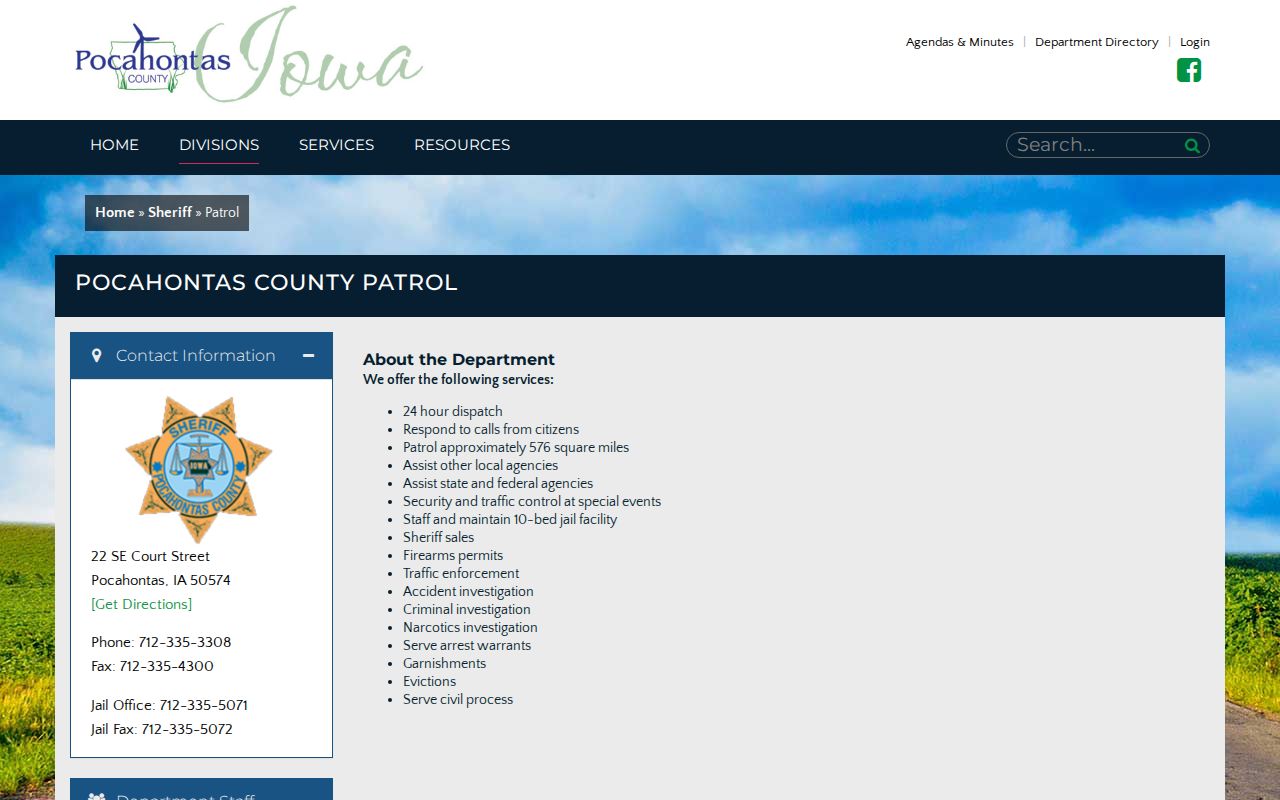
That official patrol page carries the service details and contact route, but it is no public list of people with warrants. Call Pocahontas County Sheriff dispatch at 712-335-3308 for current service confirmation. Dispatch cannot recall a warrant or set final bond terms. It cannot interpret a charge or replace advice from counsel.
Pocahontas County Arrest Warrant Privacy
Limits on pre-service access exist for a reason. Under Iowa Code section 804.29, information filed to secure an arrest warrant stays confidential until the officer makes the arrest and return or the defendant's initial appearance, with authorized criminal-justice disclosure still permitted. Iowa court guidance likewise treats criminal cases with outstanding arrest warrants as confidential until served unless a court orders otherwise. So a blank Iowa Courts Online result is not a no-warrant certificate for Pocahontas County. A new or unserved order may be restricted. A sealed case, a juvenile matter, another county's case, or an update not yet in the public index can also be missing. After service and initial appearance, more of the file may open up, though another law or court order can still keep parts of a Pocahontas County record closed.
Access rule: Ask for the public docket or a releasable served or returned record. A records request cannot force release of a confidential affidavit.
Comparing Arrest, Summons, and Bench Warrants
The label on an order tells part of the story, but the starting event matters more. A probable-cause arrest warrant begins with a complaint and sworn support. A summons or citation directs a person to appear without an immediate arrest when the law permits. A bench warrant, or failure-to-appear warrant, begins with a missed court duty, though Iowa section 805.5 calls the resulting FTA order an arrest warrant in Pocahontas County terms as elsewhere.
| Process | Starting event | Practical next check |
|---|---|---|
| Arrest warrant | Complaint and probable-cause review | Clerk for case; Sheriff for service |
| Summons or citation | Order to appear without immediate arrest | Read the date and issuing case |
| Bench or FTA warrant | Missed setting or compliance event | Ask the Clerk about reset, appearance, bond, or motion |
| Sealed warrant material | Restricted judicial filing | Request only the releasable record |
One person in Pocahontas County can carry more than one case or warrant type. A name alone cannot tell you which process applies.
Pocahontas County Warrant Confirmation
Pocahontas County publishes no public arrest-warrant list. Start with the free Iowa Courts Online docket. Search by exact case or citation number, or by full legal name. Open the blue case-number link and read the docket events. The Financial link deals with payment and does not confirm current warrant status.
- Collect the full legal name, date of birth for office confirmation, case number, and any notice.
- Search the court index and record the exact case and docket language.
- Call the Clerk at 712-335-4208 to identify the issuing court and public case status.
- Call Sheriff dispatch at 712-335-3308 for current law-enforcement service status.
- Call the jail at 712-335-5071 before any custody, surrender, or bond trip.
- Use a detailed records request when a releasable document is needed.
A Pocahontas County jail roster shows bookings only. It is not a list of active warrants, so treat it as a booking log rather than a warrant check.
If There’s an Arrest Warrant for You
First, pin down the court and case number. Ask the Pocahontas County Clerk what step the court will accept: an appearance, a motion, bond, or something else. The official county court page gives the Clerk at 99 Court Square, phone 712-335-4208. A lawyer earns their fee here, since a motion or a defense strategy can change how the warrant is handled. Then call Sheriff dispatch to learn which agency holds the order and whether the jail has instructions for you. Phone the jail before you drive anywhere. Pocahontas County publishes no guaranteed walk-in surrender process, no set bond amount, no payment method, and no release schedule. When court is not in session, Iowa's uniform bond schedule may apply, though a judge still has discretion and statutes carve out exceptions.
Act through official channels. Do not resist service or rely on a payment demand from an unknown caller. The issuing court controls recall, and a receipt alone is not a recall order.
The county’s broader resolution sequence appears in the warrant records overview.
Pocahontas County Arrest Warrant Follow-Up
An arrest is only the first step in Pocahontas County. What happens next is governed by Iowa Code section 804.21, which covers the initial appearance before a magistrate. At that hearing the court can take up the charge, appoint counsel, set release conditions, and address bond. The jail handles intake only. It does not decide the court's final remedy. The Sheriff's office reports service or return of the warrant, while the Clerk of Court records the proceedings themselves.
Follow-up matters just as much as the arrest. If an attorney arranges an appearance, or the court changes the warrant before service, ask when the order will show up in both the court docket and the law-enforcement system. Keep your case number and any written order handy. Then confirm the court status with the Clerk and the service entry with Sheriff dispatch. Checking both offices keeps an old docket line, a payment screen, or a verbal assumption from being mistaken for current clearance in Pocahontas County.
Need a document that is not online? The Iowa records-request route lets you make a verbal or written request to the custodian. Name Pocahontas County, give the case number, the record type, the date range, and how you want delivery. Reasonable expenses may apply under chapter 22. The county posts no fixed fee and no set response deadline.