
Checking for a Warrant in Rolfe
Rolfe has no separate police warrant desk, municipal court, or public city portal. Its official resident pages route law-enforcement questions to the Pocahontas County Sheriff. Search the Iowa court index under Pocahontas County with the exact citation or case number, then ask the Clerk at 712-335-4208 about the judicial record and the Sheriff at 712-335-3308 about present service information.
- Keep the Rolfe notice, citation number, date, agency, and exact name.
- Select Pocahontas County and the likely case type in Iowa Courts Online.
- Review the blue case-number docket for FTA, warrant, hearing, or Financial entries.
- Call the Clerk for court meaning and Sheriff for current service status.
- Consult an Iowa attorney before appearance, payment, bond, or surrender.
Rolfe's Sheriff-First Emergency Page
The official Rolfe Emergency Services page directs emergencies to 911 and publishes the Pocahontas County Sheriff contact. It does not identify a separate Rolfe police department, city warrant list, or warrant-specific line. This makes the Sheriff the local law-enforcement route, while the court case still belongs with the Clerk.
Sheriff Communications maintains warrant data in internal local, state, and national systems. Those tools are not a public Rolfe portal. An officer's service information may differ from what a public docket shows, so both channels matter.
The official Rolfe forms capture shows the city record route without any personal request data.
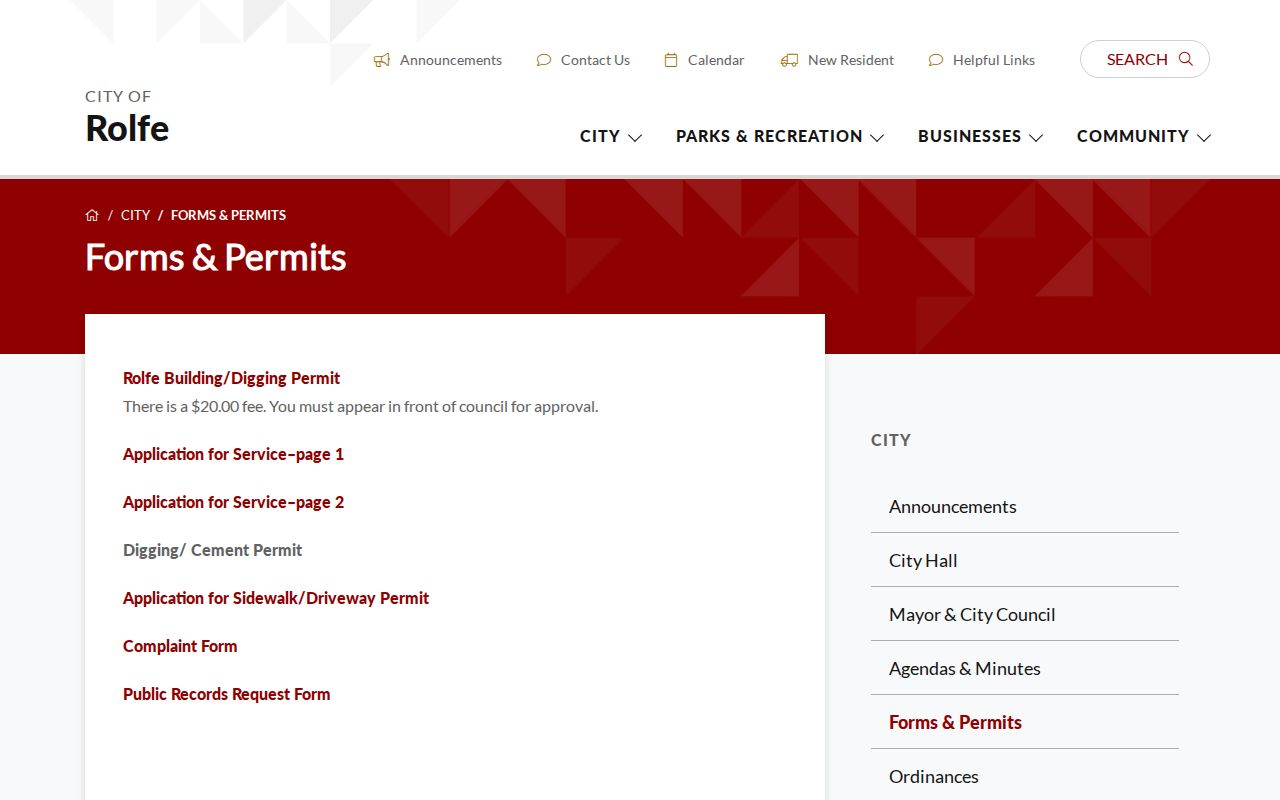
The form link is for city records generally and is not documented as a warrant-status lookup.
Rolfe Police and Municipal Court
No official source reviewed lists a separate Rolfe police department or municipal court. No city court clerk, public warrant portal, payment vendor, recall form, active list, or local amnesty was found. A Rolfe citation moves into the unified Iowa court system when filed, and a district associate judge or magistrate may handle traffic, scheduled-violation, misdemeanor, appearance, and bond matters.
City Hall can route a municipal administration question, but it cannot recall a judicial warrant. The Clerk identifies the Iowa case and judicial officer. The Sheriff handles service, and the county jail answers intake questions after the responsible offices confirm the instructions.
Rolfe City Hall's Split Hours
Rolfe City Hall is at 319 Garfield Street, Rolfe, IA 50581, phone 712-848-3124. Published hours are approximately 7:00 to noon and 1:00 to 4:00. The midday break matters for a person seeking city forms or administrative routing, but those are not court, Sheriff, jail, or bond hours.
Call the office responsible for the task before travel. A city-held administrative document may start with City Hall. A court docket or warrant order belongs with the Clerk. Current execution belongs with the Sheriff, and intake logistics belong with the jail at 712-335-5071.
The population gives civic scale, not a warrant count or caseload estimate.
Rolfe Warrant Types
Rolfe does not publish city-specific warrant categories. The Iowa court classification and underlying event control. A local ordinance may explain the cited rule, but only the docket and judicial order establish whether a warrant event occurred.
| Warrant Type | How It Arises | Who Issues It |
|---|---|---|
| Traffic-related | A required court date is missed | District associate judge or magistrate |
| Ordinance-related case | A local citation is filed in Iowa court | Authorized Iowa judicial officer |
| FTA or bench | Willful failure to appear in an applicable case | District associate judge or magistrate |
| Arrest warrant | Probable cause is found on a complaint | Magistrate or authorized judicial officer |
Rolfe Records Form Versus Court Request
The city forms page links a Public Records Request Form. That is evidence of a general route for records held by Rolfe, not proof that the form retrieves a court warrant, Sheriff record, or live service status. Its fields, fees, time, and warrant-specific use were not inspected.
| Document | Likely custodian | Safe next step |
|---|---|---|
| City administrative record | Rolfe City Hall | Ask about the city form |
| Iowa docket or warrant order | Pocahontas County Clerk | Give case and citation details |
| Sheriff service record | County law-enforcement custodian | Ask Sheriff about access and restrictions |
Juvenile, unserved, and search-warrant documents may be confidential or restricted regardless of which request route is used.
Inside a Rolfe Warrant Record
No city sample listing exists. An Iowa court result may show a case number, county, type, name, charge label, docket event, financial control, and later service or return entry. It remains a case index, not a public Rolfe law-enforcement screen.
| Case number | Keep the Iowa case number for every official call |
|---|---|
| Name | Party identity requiring careful confirmation |
| Case type | Traffic, criminal, scheduled-violation, or other classification |
| Issuing court | Iowa District Court function, not Rolfe City Hall |
| Financial data | Possible payment information that does not itself prove recall |
| Docket status | Events subject to timing and public-access limits |
If a Rolfe Citation Produces an FTA
Use the physical notice first. Search its exact number and Pocahontas County, then ask the Clerk whether an FTA or warrant event is present and which judge controls the remedy. A 10 to 14 day citation-posting delay is not permission to miss a date.
- Confirm the case number and court.
- Ask whether an appearance or judicial order is required.
- Consult counsel about the safe response.
- Call Sheriff and jail before any surrender trip.
- Recheck the docket and service status after action.
No Rolfe bond form, recall procedure, payment plan, or surrender window is published.
How Rolfe Warrants Fit the County System
A Rolfe notice moves to the Iowa District Court system when filed in Pocahontas County. The judicial officer controls the warrant event, the Clerk holds the docket, and the Sheriff receives information needed for service.
Warrant flow: Rolfe citation or complaint › Iowa District Court › County Clerk › County Sheriff and law-enforcement-only IOWA System
The state IOWA network is not public. The Pocahontas County warrant records overview explains that county layer without turning Rolfe City Hall into a warrant office.
Rolfe's New-Resident Contact Map
The official new-resident page places the Sheriff and County Clerk contacts within a resident-services route. That is useful because it sends a person toward the right county offices without implying a separate Rolfe warrant bureau. The Sheriff number addresses law enforcement; the Clerk number addresses court records.
A person who lost a citation can call City Hall for city administration or ask the Sheriff about the originating event, then give the Clerk the date, agency, name, and any number recovered. Common-name results need exact identifiers. A missing online record is not final proof because filings can lag and some records are restricted.
Rolfe routing rule: A city contact may identify a document, but only the court controls recall and only law enforcement confirms current service information.
Rolfe Warrant Records and Public Access
Iowa Code chapter 22 provides a public-record framework, but the correct custodian depends on the document. A Rolfe city record is not the same as an Iowa court docket or Sheriff service record. Requests should describe the case, date, document, and preferred format with enough detail for the responsible office.
Key Rules:
Iowa Code chapter 22, Examination of Public Records supports access subject to exceptions and reasonable costs.
Iowa Code § 804.29 restricts information used to secure an arrest warrant until the legal release point.
Iowa Code § 232.147 operates within juvenile confidentiality rules.
Rolfe Warrant Calls Before Travel
No local walk-in warrant counter, jail bond schedule, or city court calendar was located. Before driving from Rolfe, have the Clerk confirm the case, judge, and required step. Ask an attorney about risk and options. Then call the Sheriff or jail for the facility's current instructions rather than applying City Hall hours to county offices.
If an online Financial link appears, ask whether payment is authorized and whether a separate appearance or recall order remains necessary. Posting bond concerns release, not final case disposition. Keep receipts and the case number.
After any authorized action, ask the Clerk whether the newest order has posted. When service status matters, confirm it with the Sheriff. No official Rolfe source gives an update cadence, so a direct follow-up is the safest final step.
A useful call note lists the full name used on the citation, the citation or case number, the event date, and the office that issued the notice. Read those details back to the Clerk rather than relying on “a Rolfe case” as the identifier. Ask whether the file is traffic, scheduled violation, simple misdemeanor, civil infraction, or another type. That classification can determine which docket entries and judicial instructions matter.
If the purpose of the trip is only to request a city document, verify City Hall's morning or afternoon hours. If the purpose is court, Sheriff, or jail business, call that county office directly. The city schedule does not control courthouse hearings, dispatch access, intake, or bond processing. Keeping these schedules separate is especially important when a person is planning transportation from Rolfe and cannot readily make a second trip.
For a relative's matter, the same boundaries apply. Public information may help identify a case, but restricted records cannot be obtained merely by using a city form. An attorney or the person named in the case may need to speak with the Clerk. Never treat a jail roster as a warrant list, and never infer that release, absence from a roster, or a blank name search proves the court matter has ended.